The 2026 Cross-Strait Symposium on Private International Law was held in Jingzhou from October 17 to 18. Jointly organized by the China Society of Private International Law and the Taiwan Association of Private International Law,and hosted by Yangtze University, the symposium brought together nearly 50 experts and scholars and more than 40 master's and doctoral students from both sides of the Taiwan Strait. Through a combination of online and in-person sessions, participants engaged in academic discussions on topics including fundamental theories of private international law and practical issues in foreign-related judicial proceedings.
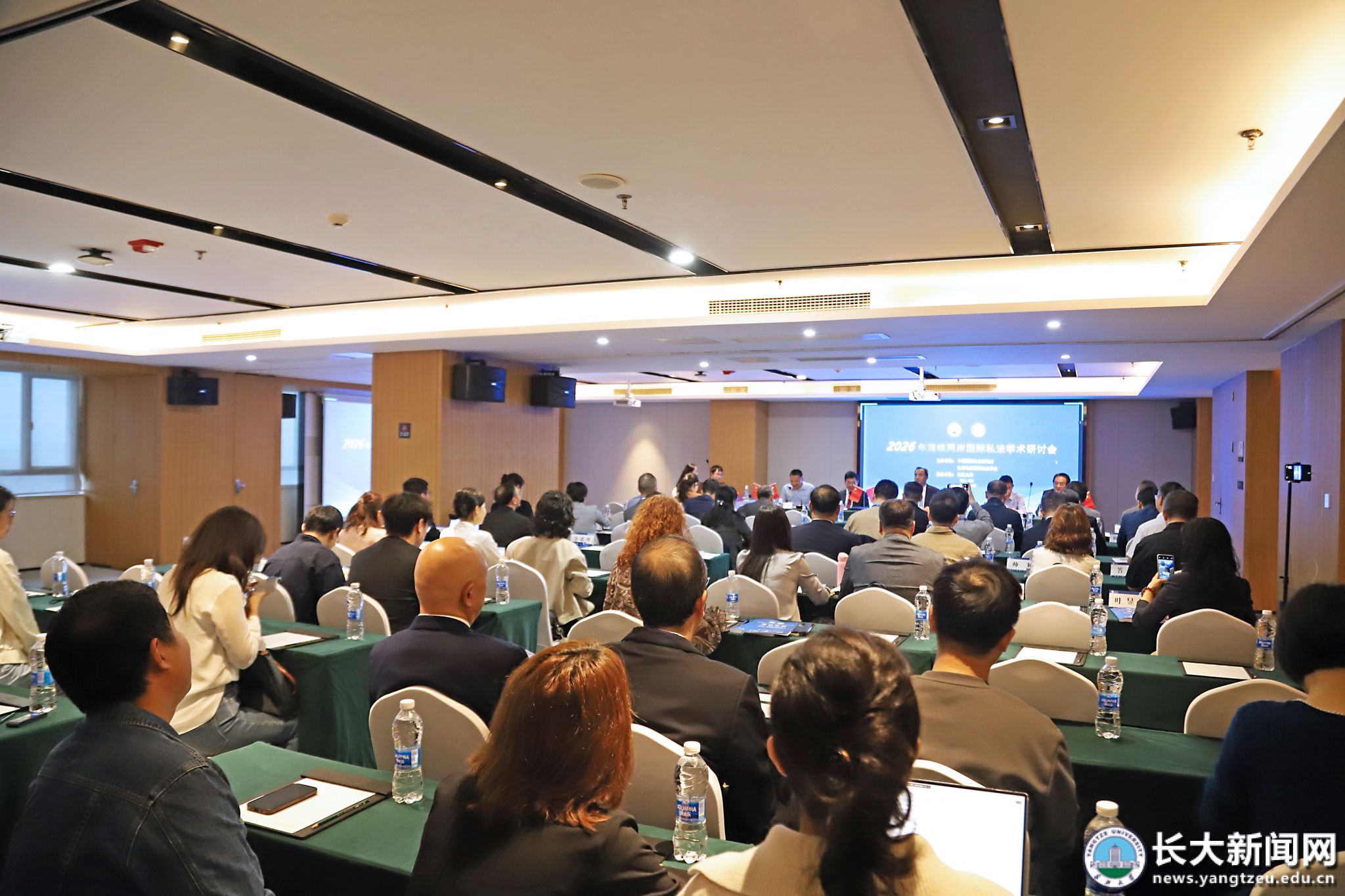
Huang Jin, President of the China Society of Private International Law and Senior Professor of Humanities and Social Sciences at Wuhan University; Lai Lai-kun, Chairmanof the Taiwan Association of Private International Law; Lü Yibing, President of Yangtze University; and Liu Renshan, Vice President of the China Society of Private International Law, attended the opening ceremony.
Lü Yibing welcomed the participating experts and scholars. He noted that Yangtze University is committed to aligning legal education and research with practical needs. In partnership with local authorities, the university has established the JingzhouForeign-Related Public Legal ServiceCenter,and organized faculty members and students to participate in practical work involving cross-border dispute resolution and the protection of intellectual property rights in foreign-related cases. He emphasized that the symposium was of great significance to advancing legal research and cultivating legal professionals at the university.
Lai Lai-kun reviewed the symposium's development since its inception in 2005, noting that it had become an established platform for regular academic exchanges among private international law scholars across the Taiwan Strait. Drawing on legislative practice concerning foreign-related civil matters in Taiwan, he observed that emerging issues such as environmental litigation, ESGconsiderations, and artificial intelligence were raising new propositions for private international law in the contemporary era. He expressed the hope that scholars on both sides would deepen mutual learning and exchange and produce more high-quality researchachievements.
Huang Jin expressed his gratitude to Yangtze University and the Jingzhou Municipal PartyCommittee and the Jingzhou Municipal Government for their support in organizing the symposium. He noted thatacademic research in law shared common roots and traditionson both sides of the Taiwan Strait.He called on legal professionals and scholars from both sides to remain committed to their academic mission, strengthen mechanisms for regular exchanges, and work together to advance the development of private international law in China, contributing to the peaceful development of cross-strait relations and thegreatcause of national rejuvenation.
The symposium featured five thematic sessions: frontier issues in private international law; international civil litigation; private international lawin family mattersanditscodification; choice of law in foreign-related adjudication; and diversified resolution of internationalcivil andcommercial disputes.Itadopted a format combining keynotereports, expertdialogueand interactive discussion.Participants explored a range of pressing and challenging issues, including cross-border carbon emissions trading, climate litigation, blockchain-based smart contracts, the recognition and enforcement of civil and commercial judgments, cross-border family disputes, the application of law in foreign-related adjudication, anddiversifieddispute resolutionunder the Belt and Road Initiative. Discussions combined theoretical analysis with case studies drawn from judicial practice on both sides, addressing theoretical development, legislative improvement and judicial practice. The sessions were marked by rigorous and lively academic exchanges.During the symposium, participants also conducted a fieldresearchin Jingzhou, integrating academic discussions with an exploration of thelocal culture.
The closing ceremony was chaired by Liu Ming, Member of the Standing Committee of the CPC Yangtze University Committee and Secretary of the Discipline Inspection Commission. Liu Renshan delivered a summary of the symposium, elaborating on the people-centered values underpinning private international law. He called on colleagues in the field on both sides of the Taiwan Strait to carry forward their academic traditions,andtosustain dialogue and exchange, applying legal expertise to promote safe and orderly civil and commercial interactions.
The symposium is widely recognized as an influential academic exchange platform in the field. This year's symposium further broadened the academic horizons of faculty members and students. Yangtze University will take this opportunity to continue strengthening its law discipline, deepen research on foreign-related rule of law, and improve the quality of education and training for professionals specializing in foreign-related legal affairs.