Professor Huang Haiping and Professor Zhu Guangyou from the School of Geosciences at Yangtze University, together with their collaborators, have recently published a research article entitled “Reassessing Gas Generation from Oil Thermal Cracking Associated with the Emeishan Large Igneous Province” in the internationally renowned journalNature Communications. The study reexamines whether methane generated from oil thermal cracking triggered by the Emeishan Large Igneous Province (ELIP) was a major driver of global climate change and the end-Permian mass extinction, while providing a reassessment of methane generation and release volumes. Yangtze University is the first affiliation listed for the paper.
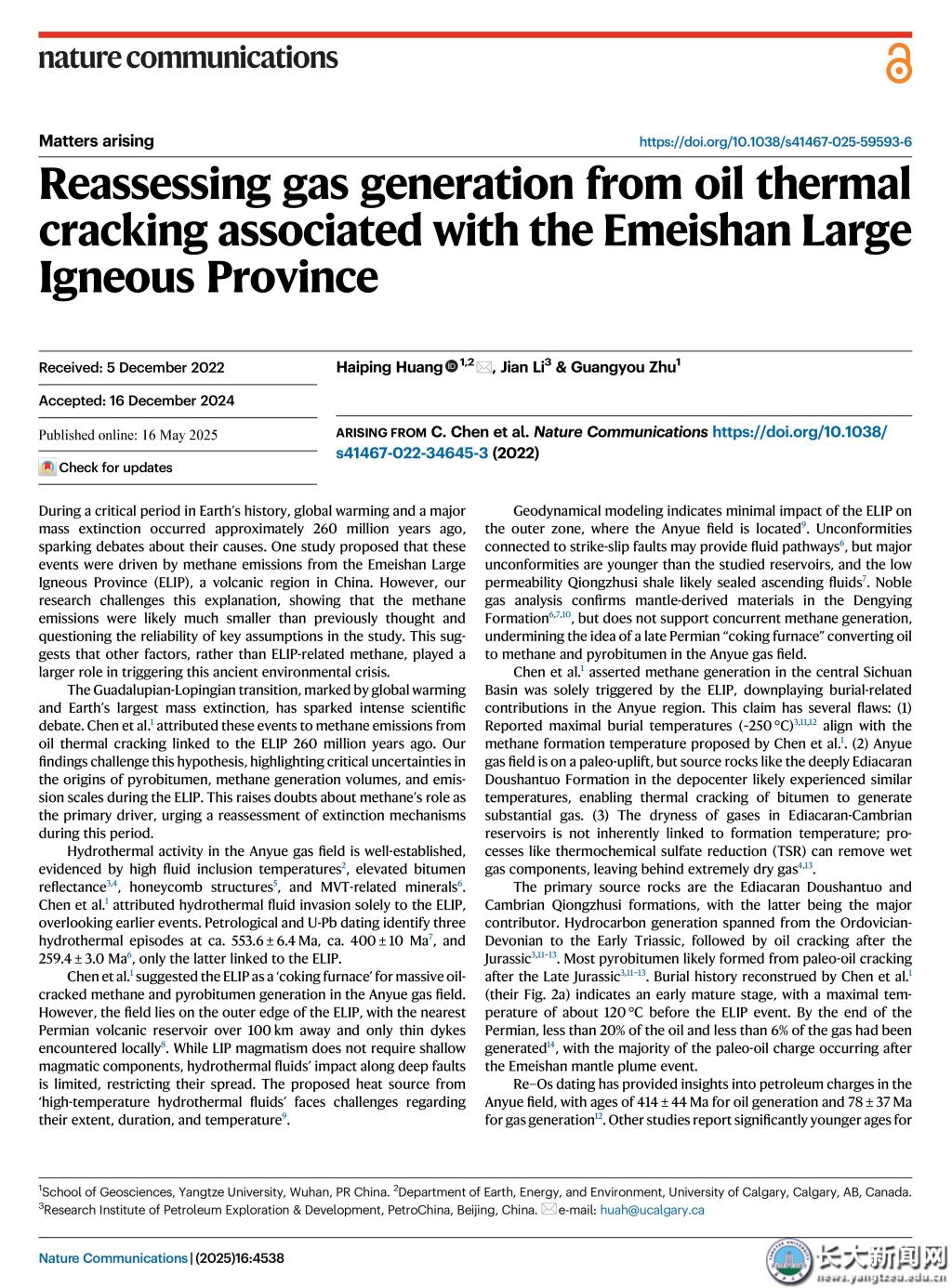
The study focused on the Anyue gas field in the Sichuan Basin as a key case study. Through systematic petrological, geochronological, and geochemical analyses, the authors identified critical uncertainties in previous studies regarding the timing of hydrothermal activity, the origin of pyrobitumen, methane generation volumes, and emission scales during the ELIP. The study also reveals that the parameters used in earlier estimates of methane release were significantly overestimated, and that the actual generation volumes were far too small to trigger a global environmental crisis. This work prompts the scientific community to revisit the link between the ELIP and catastrophic events in Earth's history, and emphasizes the need to rigorously consider gas flux, sequestration mechanisms, and regional heterogeneity when reconstructing paleoclimate and carbon cycle histories. The findings offer a fresh perspective on understanding the coupling between deep Earth processes and surface environmental systems.