The Hubei Division of the 9th SFLEP National Intercultural Competence Competition for College Students recently concluded successfully. The international student team, coached by the School of International Education and the School of Foreign Studies, impressed the judges with their fluent Chinese and heartfelt presentations, winning the Special Prize in the International Student Category and securing a place in the national final.
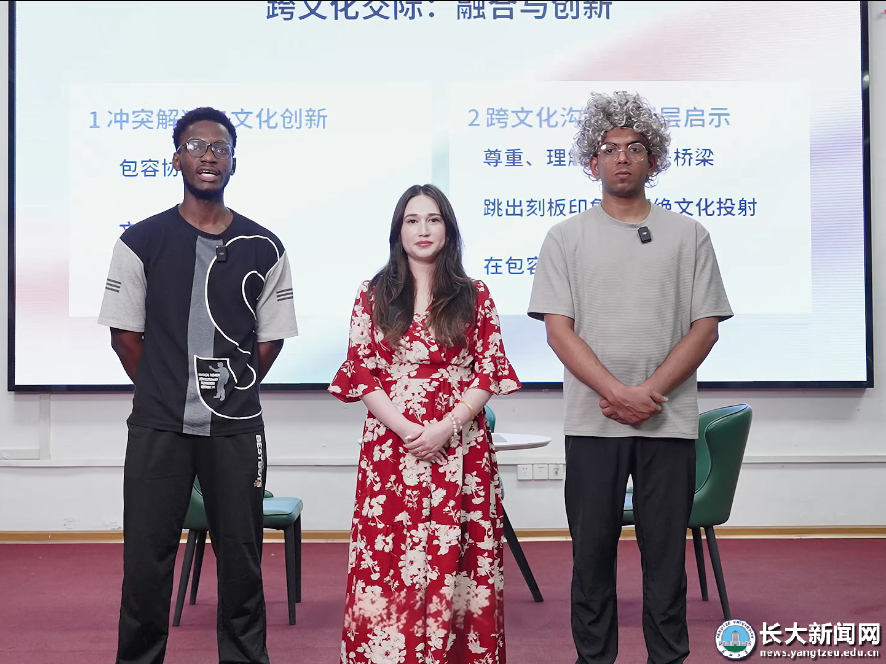
The participating students, Su Mu, Catherine, and Li An, chose similarities and differences in Chinese and foreign perspectives on love and marriage as the theme of their research. Drawing on the cultural traditions and marriage customs of the Republic of the Congo, Ecuador, and Pakistan, respectively, they also incorporated local customs and traditions of the Jingchu region, together with their own firsthand experiences of studying in Jingzhou. Through comparative research on contemporary Chinese attitudes toward love and marriage, they collected information and conducted interviews and discussions on such topics as emotional expression, family roles, partner selection, and marital responsibilities. These activities enabled them to observe Chinese society at close range, gain a deeper understanding of family values and ethics in China, strengthen their understanding of Chinese society and its national context, identify shared values across cultures, and enhance their intercultural understanding and communication skills.
During the preparation period, the School of International Education and the School of Foreign Studies assembled a team of faculty advisors to provide systematic guidance on topic selection, language refinement, and presentation techniques. In their spare time, the advisors and team members repeatedly revised the presentation scripts and refined their arguments and delivery. Through numerous discussions and rehearsals, the students deepened their understanding of Chinese culture and strengthened their critical thinking and communication skills in intercultural contexts.
Su Mu, from the Republic of the Congo, said: “This competition gave me a genuine appreciation of the differences in how people from different countries view love and marriage. More importantly, I learned to understand the historical, social, and cultural backgrounds behind these different perspectives. In the future, I will continue to observe and experience China as it really is, and share with people in Africa the warmth and sincerity reflected in Chinese family values. I hope to become a sincere ambassador of cultural exchange and help more people in my home country discover a multifaceted and vibrant China.”
Catherine, from Ecuador, remarked: “Since coming to China to study, I have found that Chinese attitudes toward love and marriage place greater emphasis on responsibility and lifelong commitment than those in Ecuador. They also value mutual dedication and reflect a blend of traditional family values and modern perspectives. I will now devote myself to preparing for the national final and continue refining our presentation. I hope to tell China's stories through my own experiences and share the openness and kindness I have encountered here, serving as a bridge for people-to-people exchanges between Ecuador and China.”
Li An, from Pakistan, said: “Through this competition, I have gained a deeper understanding of Chinese society and family values. I have also improved my ability to analyze cultural issues and express my views with confidence. Most importantly, I have learned to respect cultural differences and seek common ground. Going forward, I will strive to become a learner who understands and appreciates China and an advocate for promoting greater understanding of the country.”
The SFLEP National Intercultural Competence Competition for College Students is a highly influential national academic competition in the field of intercultural communication. Under the theme “Strengthening Cultural Confidence and Promoting International Understanding”, the competition aims to help international students gain a deeper understanding of China and share its stories with the world. It also provides a platform for mutual learning and exchange among different civilizations.