(Reporter: Li Shengjie, Photographer: Liu Jian, Correspondent: Guan Qiyue)
Wuhan, a city by the Yangtze River in July, hosted in-depth discussions on deep earth energy. On July 4, the High-End Forum on Complex Unconventional Oil & Gas Geology in South China kicked off in Wuhan. Guided by Wuhan Association for Science and Technology and hosted by Yangtze University, the forum aligns with major national strategies including national energy security, deep earth exploration, and green development under the "Dual Carbon" goals. It brought together numerous top scholars, including academicians of the Chinese Academy of Sciences and Chinese Academy of Engineering, to exchange academic insights and brainstorm innovative ideas, striving to offer Hubei wisdom and Yangtze University solutions to break through bottlenecks in the exploration and development of complex shale oil and gas, coalbed methane, and ten-thousand-meter deep formations across South China.
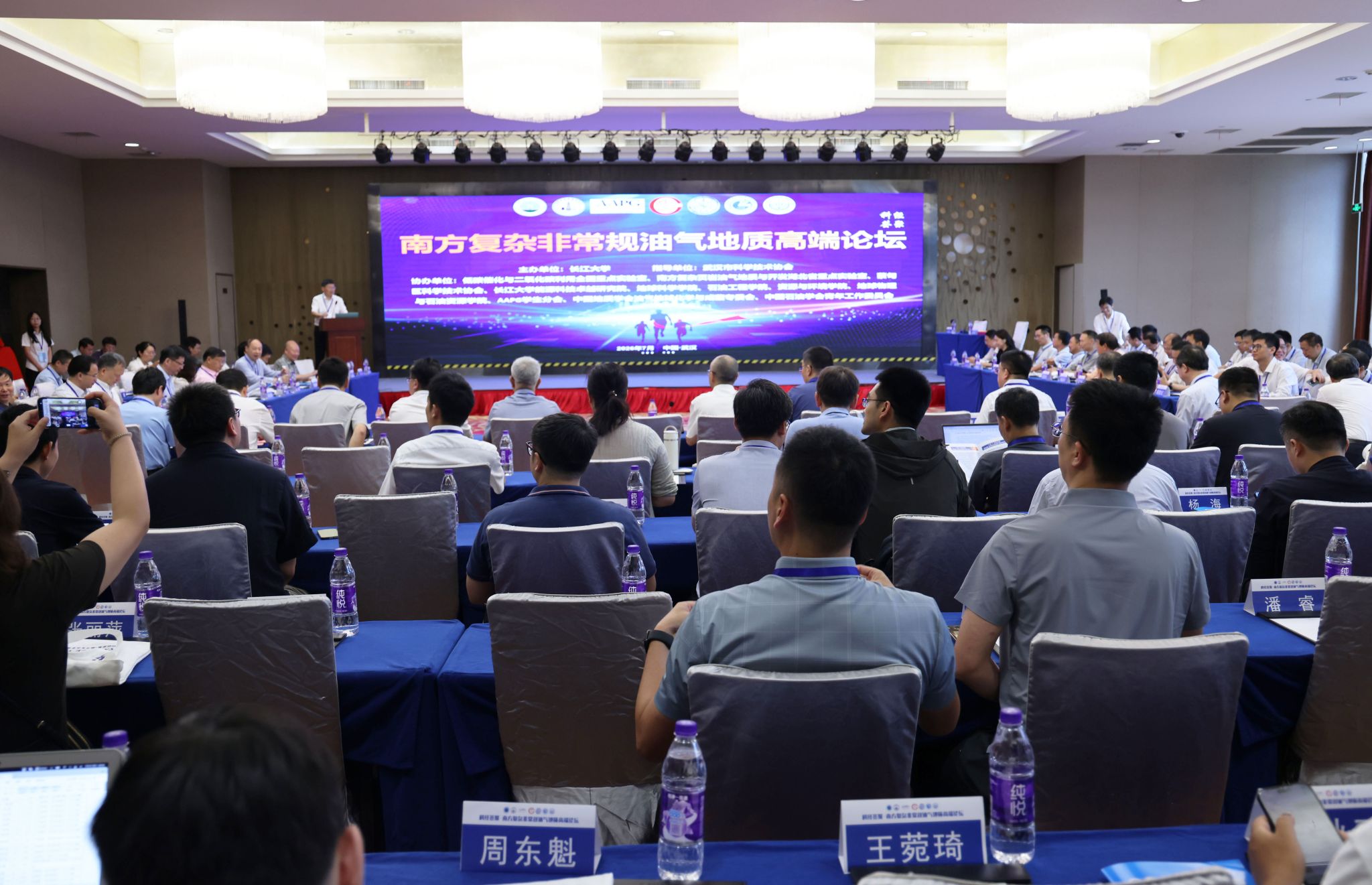
Forum participants cover the entire industrial chain of unconventional oil and gas and cross multiple interdisciplinary research fields. Distinguished attendees include Academicians Chen Yanjing and Dai Shifeng from the Chinese Academy of Sciences, Academician Xiong Shengqing from the Chinese Academy of Engineering, Fellow Cao Yunxing of the Canadian Academy of Engineering, and nearly 200 high-level experts from China National Petroleum Corporation, Sinopec, China National Offshore Oil Corporation, China State Shipbuilding Corporation, China Geological Survey, various institutes of the Chinese Academy of Sciences, Tsinghua University, Peking University and other institutions. They gathered to jointly map out plans for energy industry development.
Liu Yongsheng, Party Secretary of Yangtze University, delivered an opening address. He stated that serving national energy security stands as the core mission of Yangtze University. The university has long devoted itself to key research areas such as shale oil and gas, ten-thousand-meter deep formations, deep sea exploration, and low-carbon utilization via CCUS (Carbon Capture, Utilization and Storage), yielding a batch of original landmark research achievements. As 2026 marks a pivotal year for the university to strive for the new round of "Double First-Class" construction, Liu expressed his hope that all academicians and experts could offer valuable guidance for the development of the university’s energy disciplines, promote in-depth collaborative innovation integrating industry, academia and research, and fuel high-quality development of the energy industry.
Over two days, plenary and parallel sessions focused on the most cutting-edge and urgent scientific and engineering challenges in the industry. More than 80 thematic presentations covered frontier research directions: ultra-deep shale gas, deep sea oil and gas, petrophysics of shale reservoirs, intelligent equipment, collaborative development with CCUS, ten-thousand-meter deep well exploration, and artificial intelligence-based oil and gas evaluation. Researchers shared hands-on exploration experience and original cutting-edge theoretical findings comprehensively.
During the consultation and discussion session, academicians including Chen Yanjing, Xiong Shengqing, Dai Shifeng and Cao Yunxing offered targeted suggestions on topics such as the development path of deep earth exploration in China, technical bottlenecks in complex oil and gas exploration in South China, distinctive disciplinary development of energy studies at Yangtze University, and industry-university-research integration mechanisms for oil and gas in Hubei. All experts reached a consensus: South China features intense tectonic transformation and complex stratigraphic conditions, boasting huge resource potential in shale gas, coalbed methane and deep oil and gas. Nevertheless, prominent technical gaps remain in reservoir evaluation, drilling & completion, stimulation reconstruction, and green low-carbon development. Rooted in Hubei and dedicated to South China’s oil and gas geology, Yangtze University boasts unique geographical and disciplinary advantages. A series of new research institutes jointly built with enterprises and research institutions will effectively drive independent technological breakthroughs in deep earth energy and support national deep earth strategies and energy supply security.
A plaque-unveiling ceremony was held during the forum. Three research platforms jointly established by Yangtze University and three partner institutions were officially inaugurated in sequence: the Planned Deep Karst Research Center under UNESCO International Karst Research Center, the Research Institute of Deep Earth Exploration Technology and Equipment, and the Coalbed Methane Engineering Technology Research Institute.
Pan Xiaodong, Deputy Party Secretary of the Institute of Karst Geology, Chinese Academy of Geological Sciences; Jiao Huaiqing, Party Secretary of No.722 Research Institute of CSSC; and Ding Rong, Party Secretary of Exploration and Development Research Institute, PetroChina Coalbed Methane Company, delivered speeches respectively. They pledged to conduct collaborative research with Yangtze University focusing on complex unconventional oil and gas in South China, intelligent exploration equipment for ten-thousand-meter deep earth, and efficient development of coalbed methane in tectonically fractured zones of South China. The partnership aims to form a closed-loop innovation chain and realize two-way integration between basic research and industrial application.
Four parallel sub-sessions ran concurrently alongside the main forum:
1.Experience Sharing Workshop on Writing and Submitting Papers to Top Journals, with editors of over ten domestic academic journals on-site to answer participants’ questions;
2.Meeting of the Council of the Planned Deep Karst Research Center under UNESCO International Karst Research Center;
3.Exchange Conference on Achievements of Hubei Provincial Excellent Projects and Innovative Research Groups, where scholars and young postgraduates presented the latest experimental results on South China shale oil and gas, deep reservoirs, lithium-potassium strategic mineral resources, building a communication platform for young researchers to grow.
Zhu Guangyou, Director of the Faculty of Energy and Dean of the School of Earth Sciences, Yangtze University, commented: "This forum not only showcases major theoretical and exploration breakthroughs in unconventional oil and gas research in recent years, but also serves as a high-end exchange platform for Hubei to build a highland of deep earth energy science and technology and foster new green low-carbon productive forces for the oil and gas industry. It also delivers Hubei’s solutions for the exploration of complex unconventional oil and gas resources in South China."
Reviewer: Zhu Guangyou
Editor: Yang Yunfeng